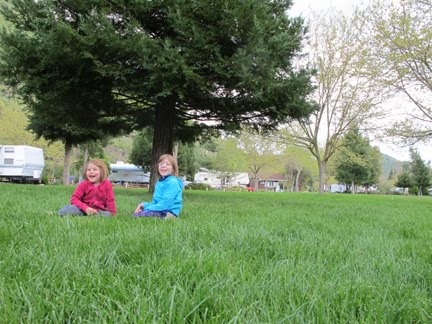
Jill's Journal: Time for one of our most favorite activities! The girls and I went on a road trip to Berkeley today to visit Golden Gate Fields, Northern California’s last major bastion of Thoroughbred racing. She’s actually a smallish track and definitely showing her age, but she’s doing it gracefully. She’s still lovely. What a fun time we had. The girls rooted home their picks in a few races and we left feeling like celebrities.
For all the crusty status the public gives horseplayers, they’re a pretty warm and welcoming bunch when they see little kids enjoying racing. We had a slew of Grandpa-types coming up to ask the girls which horse they thought was the prettiest or coming over to give them a "tip" ("bet the three!") or telling me how fun it is to see little kids enjoying a day at the track or to say that I’m a lucky Mommy. Madelyn told one older man, a kind track employee, that horses are her favorite animals. His response, “Mine too! Have fun here, you sweet babies!”
Oh yes, we had fun. The girls also made friends with a darling little girl who only spoke Spanish. Language is no barrier when it comes to kids.
Golden Gate has been in business since 1941. The legendary Bill Shoemaker won his very first career race here in 1949. And you can see the San Francisco skyline and the Golden Gate Bridge across the bay from the parking lot. It is a neat place. I’m so glad we went.
Thursday, April 14, 2011
Wednesday, April 13, 2011
Winchester Mystery House
Jill's Journal: It was another day of rain today, but yesterday the girls got to experience the extremely bizarre Winchester Mystery House for the first time. They were definitely intrigued by the eccentric Victorian mansion. In 1884, Winchester rifle heiress Sarah Winchester was reeling from the deaths of her only child and her husband. The diminutive 4’10” tall woman who spoke four languages had once been the “Belle of New Haven,” but a Boston “spiritualist” convinced her to leave Connecticut and move out West. She settled in San Jose, purchased an eight-room farmhouse, and feared the spirits of people killed by Winchester rifles – everyone from American Indians to Civil War soldiers – might be after her. The spiritualist told her the only way to ward off the vengeful spirits would be to confuse them by building a grand home for them. She did just that for the next 38 years, 24 hours a day, seven days a week, until her death. The result can only be described as a labyrinth.
The mansion tour goes through 110 of the 160 rooms (over a mile walk), but this is no run-of-the-mill mansion. There’s a staircase that leads to the ceiling. Doors less than five feet tall. Windows in floors. Doors that open to solid walls. A chimney that rises four floors and then stops just over a foot short of the ceiling. A séance room with handle-less “escape” doors. And many, many more oddities, like narrow hallways with switchbacks and hundreds of “stairs” only about two inches high. One staircase has seven flights and yet only rises a total of nine feet from bottom to top.
The front 30 rooms of the house were severely damaged in the 1906 San Francisco earthquake. (The front of the house went from seven stories to three in an instant). Winchester was trapped in one of those rooms, and upon being freed, she had the 30 rooms sealed off until after her death. Unfortunately, this included the front door. When President Teddy Roosevelt came calling (he was a huge fan of the Winchester rifle), he supposedly knocked on the front doors, only to be told by a grounds worker he could only enter through the servants’ quarters like everyone else. He was so offended he left.
For all its craziness, the house (which rambles over six acres – that’s not the size of the estate, but the size of the house alone) is also really beautiful in many places. Some of the Tiffany stained glass, imported chandeliers, and hand-inlaid parquet floors are amazing. Winchester spent over $5.5 million building the home, an unbelievable amount at that time. She also had the home about three-quarters furnished…at the time of her death, the furniture not kept by relatives, friends, and employees was auctioned off. It took six trucks six weeks to finally empty the home of its furnishings.
Photographs aren’t allowed inside, but the girls thought the whole place was pretty cool. With three elevators, 47 staircases, 2,000 doors, 10,000 windows, secret passageways, and miles of twisting hallways, it’s like a maze and the girls really, really wanted to play hide and seek there. Thank goodness there's a "no hike and seek policy" (yes, I told them that). I don’t think I would have ever found them again.
The mansion tour goes through 110 of the 160 rooms (over a mile walk), but this is no run-of-the-mill mansion. There’s a staircase that leads to the ceiling. Doors less than five feet tall. Windows in floors. Doors that open to solid walls. A chimney that rises four floors and then stops just over a foot short of the ceiling. A séance room with handle-less “escape” doors. And many, many more oddities, like narrow hallways with switchbacks and hundreds of “stairs” only about two inches high. One staircase has seven flights and yet only rises a total of nine feet from bottom to top.
The front 30 rooms of the house were severely damaged in the 1906 San Francisco earthquake. (The front of the house went from seven stories to three in an instant). Winchester was trapped in one of those rooms, and upon being freed, she had the 30 rooms sealed off until after her death. Unfortunately, this included the front door. When President Teddy Roosevelt came calling (he was a huge fan of the Winchester rifle), he supposedly knocked on the front doors, only to be told by a grounds worker he could only enter through the servants’ quarters like everyone else. He was so offended he left.
For all its craziness, the house (which rambles over six acres – that’s not the size of the estate, but the size of the house alone) is also really beautiful in many places. Some of the Tiffany stained glass, imported chandeliers, and hand-inlaid parquet floors are amazing. Winchester spent over $5.5 million building the home, an unbelievable amount at that time. She also had the home about three-quarters furnished…at the time of her death, the furniture not kept by relatives, friends, and employees was auctioned off. It took six trucks six weeks to finally empty the home of its furnishings.
Photographs aren’t allowed inside, but the girls thought the whole place was pretty cool. With three elevators, 47 staircases, 2,000 doors, 10,000 windows, secret passageways, and miles of twisting hallways, it’s like a maze and the girls really, really wanted to play hide and seek there. Thank goodness there's a "no hike and seek policy" (yes, I told them that). I don’t think I would have ever found them again.
Monday, April 11, 2011
A Sure Sign of Spring
Jill's Journal: To most people, a sure sign spring has arrived may be grass turning green or flower buds appearing. Not for me. I know it’s spring when all three of our little ones have grass stains on their britches!
We have had the most glorious, sun-speckled, low-key weekend, which the girls and I extended into after-school hours today. We swore off sightseeing for a few days and spent almost every waking hour outside in a wonderful, open grassy space just outside our RV. We’ve played “soccer,” keep away, catch, and goodness knows what else with a basketball a kind man gave to the girls a few days ago.
Victoria’s short little legs don’t quite keep up with everyone else’s yet, so she opted out of several of the games and stole my camera, telling us all she “just want(ed) to focus on picture-taking right now.” And she did! I found no fewer than 254 photos on my camera by Victoria. She is clearly my child.
Below, a sampling of life from Victoria’s perspective. I think she does quite a nice job for a 3-year-old (3 1/2-year-old, she would remind me).
We have had the most glorious, sun-speckled, low-key weekend, which the girls and I extended into after-school hours today. We swore off sightseeing for a few days and spent almost every waking hour outside in a wonderful, open grassy space just outside our RV. We’ve played “soccer,” keep away, catch, and goodness knows what else with a basketball a kind man gave to the girls a few days ago.
Victoria’s short little legs don’t quite keep up with everyone else’s yet, so she opted out of several of the games and stole my camera, telling us all she “just want(ed) to focus on picture-taking right now.” And she did! I found no fewer than 254 photos on my camera by Victoria. She is clearly my child.
Below, a sampling of life from Victoria’s perspective. I think she does quite a nice job for a 3-year-old (3 1/2-year-old, she would remind me).
Saturday, April 9, 2011
Morgan Hill, CA
Jill's Journal: You would think this distinctive hill would be called “Morgan Hill” since that’s the name of the town we’re in. Nope. It’s named “El Toro,” as in “bull” in Spanish. The town is actually named after the man who founded it by building a country estate here in 1884, Hiram Morgan Hill.
Whatever its naming history, we quite like Morgan Hill. It’s a bedroom community for San Jose and the Silicon Valley, quite rural in places and just all-around nice. It never would have been a destination for us without the campground debacle I wrote about a week ago, but it’s been a really nice stopover. So nice, in fact, that we’ve decided to stay another week.
There are a few more things within comfortable driving distance that we wouldn’t mind seeing and it makes more sense to do it from here, where we have a little room to breath in a nice campground at a semi-reasonable price. Our next stop will be just south of San Francisco where we’ll have approximately four feet between us and our nearest neighbors at an outrageous price, so we’ll focus on only the big city during that time…and then hurry the heck out of there.
Whatever its naming history, we quite like Morgan Hill. It’s a bedroom community for San Jose and the Silicon Valley, quite rural in places and just all-around nice. It never would have been a destination for us without the campground debacle I wrote about a week ago, but it’s been a really nice stopover. So nice, in fact, that we’ve decided to stay another week.
There are a few more things within comfortable driving distance that we wouldn’t mind seeing and it makes more sense to do it from here, where we have a little room to breath in a nice campground at a semi-reasonable price. Our next stop will be just south of San Francisco where we’ll have approximately four feet between us and our nearest neighbors at an outrageous price, so we’ll focus on only the big city during that time…and then hurry the heck out of there.
Friday, April 8, 2011
Watsonville and Capitola
Jill's Journal: On an unseasonably cool day, the girls and I braved the rain for an afternoon jaunt first to Watsonville and then to Capitola. Talk about two different worlds. First, Watsonville – all agriculture. The snapshot above was out of a moving vehicle (hopefully the laws about texting while driving don’t apply to photographing while driving!). We passed what had to be miles and miles that looked just like this.
Our destination in Watsonville was the Agricultural History Project/Farm Museum and Education Center. We learned a ton about the (mostly former) dairy industry in the area, plus a little about the huge apple industry and other crops from the region. The girls were especially interested in learning how vegetables go from the field to the freezer of the nation’s grocery stores. I don’t think many people outside of this state realize or appreciate California’s massive agricultural contribution to the country and world.
The highlight was a kind older lady who showed the girls how to make dolls out of yarn, just like they did in the old days. Much to their delight, each girl got to take one home.
And then it was off to Capitola, only about 15 minutes away but a world apart. Capitola is darling and quaint with its colorful buildings right on the ocean. It’s almost reminiscent of a Mediterranean-type village in Italy. It also happens to be the oldest beach resort on the West Coast. An 1883 advertisement was already billing it as such. Little one-room cottages (such as this one built in 1907) are the type of beach houses vacationers would rent during the summer season. Half-hidden behind it to the left are the “bath houses” vacationers would all share. While there was no charge to use the toilets, things we take for granted not just “on holiday” but also everyday (like towels and baths or showers) were available for a small fee! Wool bathing suits, the standard of the time, were also available for rent.
Our destination in Watsonville was the Agricultural History Project/Farm Museum and Education Center. We learned a ton about the (mostly former) dairy industry in the area, plus a little about the huge apple industry and other crops from the region. The girls were especially interested in learning how vegetables go from the field to the freezer of the nation’s grocery stores. I don’t think many people outside of this state realize or appreciate California’s massive agricultural contribution to the country and world.
The highlight was a kind older lady who showed the girls how to make dolls out of yarn, just like they did in the old days. Much to their delight, each girl got to take one home.
And then it was off to Capitola, only about 15 minutes away but a world apart. Capitola is darling and quaint with its colorful buildings right on the ocean. It’s almost reminiscent of a Mediterranean-type village in Italy. It also happens to be the oldest beach resort on the West Coast. An 1883 advertisement was already billing it as such. Little one-room cottages (such as this one built in 1907) are the type of beach houses vacationers would rent during the summer season. Half-hidden behind it to the left are the “bath houses” vacationers would all share. While there was no charge to use the toilets, things we take for granted not just “on holiday” but also everyday (like towels and baths or showers) were available for a small fee! Wool bathing suits, the standard of the time, were also available for rent.
Thursday, April 7, 2011
Quiet Time
Jill's Journal: Does it always rain this much in the northern part of Central California? I think it’s unusual, but my goodness, we’ve seen a crazy amount of rain in the last few months. The girls and I had planned to go to San Jose today, but driving on busy freeways in the rain is something I like to avoid if I can... And today I could, so I did.
It turned out to be the perfect day for a little extra quiet time. Victoria was so engrossed in her book she didn’t even notice me snapping her picture.
Wednesday, April 6, 2011
Rosicrucian Egyptian Museum
Jill's Journal: When you have a 7-year-old who thinks Ancient Egyptian history is the Greatest Thing Ever, you take advantage of little opportunities like visiting the largest collection of Egyptian artifacts in the western United States. The girls and I headed to lovely downtown San Jose (which, I was surprised to learn, is the third-largest city in California) and the Rosicrucian Egyptian Museum. My only regret is we just spent the afternoon there; we should have spent a full day.
We walked in the front doors to immediately see a full-sized, full-detailed recreation of King Tut’s innermost coffin. Erika’s face positively shown. She was awed and enthralled and just so happy. It was awesome. And it just got better.
This girl knows her Egyptian facts. Time after time, she’d take my hand and say, “Oh look, Mommy, there’s the goddess (fill-in-the-blank) or there’s the symbol (fill-in-the-blank) or there’s the hieroglyphic for (fill-in-the-blank). I’d walk up to read the description and she was right every time. This girl knows her stuff. It was amazing.
More than once, I’d point to an odd-looking creature and she’d say, “That’s the symbol for the god (fill-in-the-blank) and he represents (fill-in-the-blank).” I was floored. Her current “what I want to be when I grow up” is an archeologist or a missionary, “or maybe a combination of both.” I’d say she’s on the right path.
This guy is one of the stars of the show. He’s one of four mummies on display at the museum (the girls were particularly touched by a 4 1/2-year-old girl mummy from Egypt’s Roman period, about the time of Christ’s birth). This upper-class man is one of the best-preserved mummies in the world. Seriously, we could see the details in his fingernails and his tongue and so much more. He dates to somewhere between 1500 and 1000 BC. It is believed graverobbers bothered him around 400 BC and priests rewrapped him at that time in the linens he still wears.
Egyptian “pillows,” used only when sleeping on one’s back.
Hieroglyphic and/or cuneiform tablets. Amazing collection.
One of the rarest statues in the world: Cleopatra VII. Egypt’s most famous queen and her complicated relationship with the Roman Empire have gone down in infamy. She took first Julius Caesar as her lover and then Mark Anthony before committing suicide via an asp (believed to be the snake we call a cobra) when Egypt was defeated by the Romans. After her death, the Romans destroyed every likeness of her they could find. Only seven, of various sizes, have survived.
Statue of the goddess Sekhmet, patroness of diseases and healing, commissioned by Amenhotep III (recognized as Egypt’s most prosperous and internationally powerful pharaoh) in the 1300s BC.
Major added bonus: This week, we’ve been studying Babylon in 1st grade history. These large fragments are part of the ruins of King Nebuchadnezzar II’s palace (yes, that famous king from the Old Testament!) and the Hanging Gardens he built for his homesick wife. The Hanging Gardens were one of the seven Ancient Wonders of the World. We also saw several other Babylonian and Nebuchadnezzar artifacts – I can’t describe how utterly fantastic it is to see these real items from the ancient world in the exact week we’re studying them. Just awesome. Talk about driving points home.
Three little girls couldn’t resist a little twirling in the Egyptian Peace Garden as the shadows grew long after our wonderful excursion. I have actually discovered one downside to all our traveling: these girls now believe every place in the world is very accessible. So accessible, in fact, that they just can’t understand why we should go to an Egyptian museum when we could just visit Egypt itself and see the pyramids up close and personal. Funny girls. Someday they’ll appreciate the opportunities they’re being given.
We walked in the front doors to immediately see a full-sized, full-detailed recreation of King Tut’s innermost coffin. Erika’s face positively shown. She was awed and enthralled and just so happy. It was awesome. And it just got better.
This girl knows her Egyptian facts. Time after time, she’d take my hand and say, “Oh look, Mommy, there’s the goddess (fill-in-the-blank) or there’s the symbol (fill-in-the-blank) or there’s the hieroglyphic for (fill-in-the-blank). I’d walk up to read the description and she was right every time. This girl knows her stuff. It was amazing.
More than once, I’d point to an odd-looking creature and she’d say, “That’s the symbol for the god (fill-in-the-blank) and he represents (fill-in-the-blank).” I was floored. Her current “what I want to be when I grow up” is an archeologist or a missionary, “or maybe a combination of both.” I’d say she’s on the right path.
This guy is one of the stars of the show. He’s one of four mummies on display at the museum (the girls were particularly touched by a 4 1/2-year-old girl mummy from Egypt’s Roman period, about the time of Christ’s birth). This upper-class man is one of the best-preserved mummies in the world. Seriously, we could see the details in his fingernails and his tongue and so much more. He dates to somewhere between 1500 and 1000 BC. It is believed graverobbers bothered him around 400 BC and priests rewrapped him at that time in the linens he still wears.
Egyptian “pillows,” used only when sleeping on one’s back.
Hieroglyphic and/or cuneiform tablets. Amazing collection.
One of the rarest statues in the world: Cleopatra VII. Egypt’s most famous queen and her complicated relationship with the Roman Empire have gone down in infamy. She took first Julius Caesar as her lover and then Mark Anthony before committing suicide via an asp (believed to be the snake we call a cobra) when Egypt was defeated by the Romans. After her death, the Romans destroyed every likeness of her they could find. Only seven, of various sizes, have survived.
Statue of the goddess Sekhmet, patroness of diseases and healing, commissioned by Amenhotep III (recognized as Egypt’s most prosperous and internationally powerful pharaoh) in the 1300s BC.
Major added bonus: This week, we’ve been studying Babylon in 1st grade history. These large fragments are part of the ruins of King Nebuchadnezzar II’s palace (yes, that famous king from the Old Testament!) and the Hanging Gardens he built for his homesick wife. The Hanging Gardens were one of the seven Ancient Wonders of the World. We also saw several other Babylonian and Nebuchadnezzar artifacts – I can’t describe how utterly fantastic it is to see these real items from the ancient world in the exact week we’re studying them. Just awesome. Talk about driving points home.
Three little girls couldn’t resist a little twirling in the Egyptian Peace Garden as the shadows grew long after our wonderful excursion. I have actually discovered one downside to all our traveling: these girls now believe every place in the world is very accessible. So accessible, in fact, that they just can’t understand why we should go to an Egyptian museum when we could just visit Egypt itself and see the pyramids up close and personal. Funny girls. Someday they’ll appreciate the opportunities they’re being given.
Tuesday, April 5, 2011
Gilroy, Garlic Capital of the World
Jill's Journal: This afternoon, we headed a little south with visions of garlic dancing in our heads. Gilroy is the home of a massive garlic festival in the summer and we felt sure we’d learn more about garlic than we ever dreamed. It was actually a little bit of a bust – we found out very little about garlic, but we did find garlic ice cream.
Amazingly Rob liked it, but one bite about did me in. To their credit, the girls all tried it, but only Victoria was daring enough to have a second bite. She told us she liked it, but I suspect she didn’t really mean it as she was hanging out her tongue in misery and giving the “bad taste shiver” as she said it. Too funny.
Gilroy is the self-proclaimed “Garlic Capital of the World.” And we believe it! We could smell garlic almost immediately after we crossed into the city limit. The amount of garlic shops and garlic markets and garlic restaurants was truly spellbinding. We purchased a few garlic products, but I personally won’t be delving in anytime soon, in spite of what I thought was a love of garlic – that ice cream is going to haunt me for a while!
Amazingly Rob liked it, but one bite about did me in. To their credit, the girls all tried it, but only Victoria was daring enough to have a second bite. She told us she liked it, but I suspect she didn’t really mean it as she was hanging out her tongue in misery and giving the “bad taste shiver” as she said it. Too funny.
Gilroy is the self-proclaimed “Garlic Capital of the World.” And we believe it! We could smell garlic almost immediately after we crossed into the city limit. The amount of garlic shops and garlic markets and garlic restaurants was truly spellbinding. We purchased a few garlic products, but I personally won’t be delving in anytime soon, in spite of what I thought was a love of garlic – that ice cream is going to haunt me for a while!
Monday, April 4, 2011
“THE Craft of My Life!”
Jill's Journal: I’ve mentioned that Erika is completely obsessed with anything Egyptian. Today we built a pyramid out of sugar cubes and glue. I haven’t got a crafty bone in my body, so it’s neat to see these little girls so excited about what I can muster as “Art.” Here’s Erika’s finished product.
Erika thought the whole process was the most wonderful thing in the world. In fact, the direct quote was, “This is THE craft of my life!”
The little girls got to make their own creations as well. We ended up with not pyramids, but a “playground” or a “swimming pool with lots of diving boards” or a “city” (they kept changing their minds). Personally, I think they were just excited to have carte blanche with glue.
Erika thought the whole process was the most wonderful thing in the world. In fact, the direct quote was, “This is THE craft of my life!”
The little girls got to make their own creations as well. We ended up with not pyramids, but a “playground” or a “swimming pool with lots of diving boards” or a “city” (they kept changing their minds). Personally, I think they were just excited to have carte blanche with glue.
Sunday, April 3, 2011
California “Campgrounds”
Jill's Journal: We prefer positive thinking around here, but every now and then even the “sunny side of optimism” can get worn down. California campgrounds are doing that to us. Oh, the frustration! While I hate to compare East vs. West, our experiences with campgrounds on the East Coast are head and shoulders above those on the West Coast, or at least in California. Let me explain.
All up the East Coast, we’d make our campground reservations and show up to delight in each new place. There was never a problem and we never questioned our safety. And, the sheer amount of campgrounds available in the East keep things competitive: to survive, campgrounds have to be well-maintained, safe, and economical.
California, on the other hand, has been a major eye-opener. Campgrounds as we think of them seem to be state parks here, which were pretty much all built long before large RVs and 99% don’t fit our rig. The private campgrounds here seem to be more along the lines of what we think of as “trailer parks.” Now, I’m sure there’s plenty of lovely people at trailer parks, but there’s so many unsavory characters milling about that I don’t want to take the time to find out with little kids in tow. The actual campgrounds in California, as we were used to on the East Coast, are few and very far between, are ridiculously expensive, often don’t give one that warm and fuzzy and safe feeling, and are sometimes anything but well-maintained. And it’s getting old.
To save what would be a really long story, yesterday we once again showed up at a “campground,” only to find something so shady (and in a rough area of town) we would have been afraid to even let the children out of the car (and most certainly didn’t). We quickly searched online and in our camping directory for something else in the area and it was just more of the same. We put on around 100 extra miles – which is no easy task with pulling a fifth wheel in traffic – and a mountain of frustration to finally end up in an area far south and far inland of where we intended.
We’re now in what feels like the middle of nowhere, a community called Morgan Hill, but it seems nice and at least it feels safe for the kids (always our primary concern). It’s somewhere south of San Jose. We had started our campground search yesterday in Redwood City, about 45 miles north of where we ended up. Like I said, the campground situation in California is getting old. We’re hoping it improves once we get north of San Francisco. We hope.
All up the East Coast, we’d make our campground reservations and show up to delight in each new place. There was never a problem and we never questioned our safety. And, the sheer amount of campgrounds available in the East keep things competitive: to survive, campgrounds have to be well-maintained, safe, and economical.
California, on the other hand, has been a major eye-opener. Campgrounds as we think of them seem to be state parks here, which were pretty much all built long before large RVs and 99% don’t fit our rig. The private campgrounds here seem to be more along the lines of what we think of as “trailer parks.” Now, I’m sure there’s plenty of lovely people at trailer parks, but there’s so many unsavory characters milling about that I don’t want to take the time to find out with little kids in tow. The actual campgrounds in California, as we were used to on the East Coast, are few and very far between, are ridiculously expensive, often don’t give one that warm and fuzzy and safe feeling, and are sometimes anything but well-maintained. And it’s getting old.
To save what would be a really long story, yesterday we once again showed up at a “campground,” only to find something so shady (and in a rough area of town) we would have been afraid to even let the children out of the car (and most certainly didn’t). We quickly searched online and in our camping directory for something else in the area and it was just more of the same. We put on around 100 extra miles – which is no easy task with pulling a fifth wheel in traffic – and a mountain of frustration to finally end up in an area far south and far inland of where we intended.
We’re now in what feels like the middle of nowhere, a community called Morgan Hill, but it seems nice and at least it feels safe for the kids (always our primary concern). It’s somewhere south of San Jose. We had started our campground search yesterday in Redwood City, about 45 miles north of where we ended up. Like I said, the campground situation in California is getting old. We’re hoping it improves once we get north of San Francisco. We hope.
Saturday, April 2, 2011
Farewell Felton!
Jill's Journal: We had no expectations going into this wacky little town, so it was a pleasant surprise to find how much we enjoyed it. This was Erika and her fellow 7-year-old, homeschooling, Texan friend this morning, just as we were saying goodbye. We really had fun comparing notes with another full-timing family this week and the kids of course had great times together. We exchanged email addresses as we left, so who knows? Maybe we’ll cross paths again.
And why is it that our kids are always so much taller than other kids their age? I don’t think it’ll be too many years before all our girls pass me up. I’m the shortest one in my family at 5’5”, so clearly Rob’s 6’3”-ishness is to blame.
I didn’t get a picture, but Madelyn, shown here climbing her favorite redwood trunk, made sure she hugged our “gnarly” friend goodbye. We all really liked him (what a good guy!), but she especially thought he was the cat’s meow. The 33-year-old surfer and three-years-clean recovering drug addict was a complete sweetheart and had such a knack with the girls. We’ve seen him every day for the last week, multiple times a day. I think we’ll even miss him!
And why is it that our kids are always so much taller than other kids their age? I don’t think it’ll be too many years before all our girls pass me up. I’m the shortest one in my family at 5’5”, so clearly Rob’s 6’3”-ishness is to blame.
I didn’t get a picture, but Madelyn, shown here climbing her favorite redwood trunk, made sure she hugged our “gnarly” friend goodbye. We all really liked him (what a good guy!), but she especially thought he was the cat’s meow. The 33-year-old surfer and three-years-clean recovering drug addict was a complete sweetheart and had such a knack with the girls. We’ve seen him every day for the last week, multiple times a day. I think we’ll even miss him!
Friday, April 1, 2011
Roaring Camp Railroad
Jill's Journal: Today we experienced what was probably the highlight of our time in Felton, the Roaring Camp Railroad. An 1800-era steam engine took us on North America’s steepest narrow-gauge railroad grade through the redwood forest.
It was like going back in time. The ambience couldn’t be beat. The depot “town” was built like a small, late 1800s-era community and when that steam engine pulled into the station, people got excited. The sight and sound and smell and rumble of that locomotive gave one such an appreciation of what a BIG deal trains were to America over a century ago. You grow up hearing in elementary history class how trains changed the country, but until you actually see one of these vintage steam engines in all its glory, I don’t know if it’s possible to really appreciate it. These days, we take things for granted. Back then, it had to have been the most impressive thing people had seen and probably would ever see in their lifetimes.
The Dixiana, the engine that pulled us, was once used by a lumber company on the Smokey Mountain Railroad in Tennessee. In 1958, the original founder of Roaring Camp found her abandoned at a defunct coal mine in Dixiana, Virginia. She was put back in service when Roaring Camp opened in 1963 (on rails that had been shipped around South America’s Cape Horn in 1881).
Railroads have been carrying tourists to the big trees since 1875. The desire to preserve a piece of the 1800s-appreciation for both steam engines and redwoods led to Roaring Camp.
It is so cool to travel up a winding, narrow-gauge track through the towering redwoods. I don’t know if the sight of those spectacular big trees would ever get old. They are simply magnificent. The trees within a few feet of the steam from the engine were all blackened by the soot, which only added to the great old-time atmosphere.
Back in the 1880s, narrow-gauge steam locomotives were used by foresters to move the giant redwood logs out of the mountains. Roaring Camp’s locomotives are among the oldest and most authentically-preserved steam engines in the world that still provide passenger service. In fact, three of the engines (including the Dixiana) at Roaring Camp have been designated as National Mechanical Engineering Historical Landmarks.
Rob put three pennies down on the narrow-gauge track for the train to flatten. We picked them up later as souvenirs for the girls.

It was like going back in time. The ambience couldn’t be beat. The depot “town” was built like a small, late 1800s-era community and when that steam engine pulled into the station, people got excited. The sight and sound and smell and rumble of that locomotive gave one such an appreciation of what a BIG deal trains were to America over a century ago. You grow up hearing in elementary history class how trains changed the country, but until you actually see one of these vintage steam engines in all its glory, I don’t know if it’s possible to really appreciate it. These days, we take things for granted. Back then, it had to have been the most impressive thing people had seen and probably would ever see in their lifetimes.
The Dixiana, the engine that pulled us, was once used by a lumber company on the Smokey Mountain Railroad in Tennessee. In 1958, the original founder of Roaring Camp found her abandoned at a defunct coal mine in Dixiana, Virginia. She was put back in service when Roaring Camp opened in 1963 (on rails that had been shipped around South America’s Cape Horn in 1881).
Railroads have been carrying tourists to the big trees since 1875. The desire to preserve a piece of the 1800s-appreciation for both steam engines and redwoods led to Roaring Camp.
It is so cool to travel up a winding, narrow-gauge track through the towering redwoods. I don’t know if the sight of those spectacular big trees would ever get old. They are simply magnificent. The trees within a few feet of the steam from the engine were all blackened by the soot, which only added to the great old-time atmosphere.
Back in the 1880s, narrow-gauge steam locomotives were used by foresters to move the giant redwood logs out of the mountains. Roaring Camp’s locomotives are among the oldest and most authentically-preserved steam engines in the world that still provide passenger service. In fact, three of the engines (including the Dixiana) at Roaring Camp have been designated as National Mechanical Engineering Historical Landmarks.
Rob put three pennies down on the narrow-gauge track for the train to flatten. We picked them up later as souvenirs for the girls.
Subscribe to:
Posts (Atom)