Jill's Journal: We found Kings Canyon National Park, outside of Fresno, California, to be an unexpected gem.
Located in the southern Sierra Nevadas, it’s very close (as the crow flies) to the more-heralded Yosemite National Park to the north and the adjacent Sequoia National Park to the south. Mt. Whitney, the tallest point in the contiguous 48 states, is immediately over the ridge to the east (with Death Valley just a little farther east of that). The San Joaquin Valley, the heart of California’s agriculture, is immediately to the west.
Much of the landscape of Kings Canyon is reminiscent of Yosemite, but only slightly less spectacular, and with the exception of the Giant Sequoia groves, very much without the heavy crowds and high traffic of its more famous cousin. With only a tiny percentage of the park available to vehicles, this is nature as its most pristine and must be a hiker’s paradise. Have I mentioned it’s beautiful? Around every bend, it just gets prettier and prettier.
Kings Canyon is best known for its Giant Sequoias. Can you spot the girls, looking like tiny specks, in the parking lot standing near the base of one?
Although often confused, Sequoias are very different from Coastal Redwoods, which we spent a lot of time visiting up the coast last year. While both have reddish wood, can be a couple thousand years old, and are found almost entirely in California, they are very different trees. Sequoias are the widest trees in the world; Redwoods are the tallest. Sequoias grow only inland and generally at altitude (found only in the Sierra Nevadas above 4,800 feet); Redwoods grow only near the Pacific Coast, primarily in Northern California and very Southern Oregon. Redwoods grow in clusters; Sequoias are usually more like lone wolfs. Both are absolutely majestic in their own way, although having now seen both, we’d have to admit if pressed we think the Redwoods are more impressive.
This Giant Sequoia is the General Grant Tree, the third-largest tree in the world by volume. And with a trunk at over 40 feet in diameter, it is the widest-known tree in the world.
With a height of 268 feet and an age of about 1,700 years, the tree is wider (at the base) than a three-lane freeway and weighs more than 700 large cars. It is something to behold indeed. Discovered in 1862 during the Civil War, it was named for the leader of the Union forces (and later our 18th president).

The General Grant Tree was named the “Nation’s Christmas Tree” by President Calvin Coolidge in 1926. Thirty years later, President Dwight D. Eisenhower would proclaim it a National Shrine, a memorial to those who gave their lives for our country. It’s impossible to show the scope of the world's widest tree in a photograph (this picture is taken from quite far away), particularly as the tree is fenced off to protect it from human traffic/damage. In a now-funny moment, the Grant Grove was crawling with French tourists (there were dozens!) on the day we were there. One rude Frenchman leaped the fence so his companions could get pictures of him with the tree. While everyone else gaped at the man’s audacity, Rob wasn’t about to let that go and yelled --in his most stern Dad voice-- at the Frenchman in no uncertain terms to get out of that fence immediately. He certainly got the attention of the scores of other tourists around us. One American lady said to Rob, “Well done!”

Giant Sequoias require occasional fire to thrive; the Grant Tree bears fire scars.
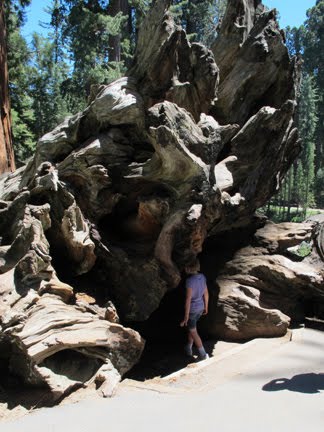
Here’s the girls at the base of a fallen Giant Sequoia. You’ll realize how big it is in the next photo…
…when you see Erika going down steps to get inside.
Inside the Sequoia! The tree had already fallen some time before when it was used as an employee camp at the time General Grant National Park was established in 1890 (this park was folded into Kings Canyon in 1940). Later, it was used as a house for homesteaders and then as a hotel and saloon to serve visitors refreshments. Eventually, the U.S. Calvary used it as a stable, housing up to 32 horses in it at a time.
The wood on these trees decays very slowly, as a high tannin content repels insects, fungi, and bacteria. No one knows how long this tree, called the Fallen Monarch, has lain here although it is believed to be centuries.
Giant trees aren’t the only attraction in Kings Canyon. There are lovely vistas with deep canyons…
…spectacular meadows (I fell head over heals in love with this one)…
…unusual plants…
…the Kings River…
…and stunning waterfalls. This 75-foot one was called Grizzly Falls and is just a short walk from the main road.
One of our favorite places was near “Road’s End,” where, you guessed it, the road ends. There’s a trail to “Zumwalt Meadow,” which starts with this beautiful spot. Before man intervened and built a reservoir downriver, this water flowed all the way down to the San Joaquin Valley. Spanish explorers first saw it in 1805 and named it El Rio de los Santos Reyes, or River of the Holy Kings. Take that original name along with the many canyons in this area (some of the deepest in the U.S. at over 8,000 feet and one specifically named Kings Canyon) and the moniker of Kings Canyon National Park was born.
Here’s the sheer face of North Dome, which rises above the canyon floor more than 3,600 feet. That's nearly identical to the more famed El Capitan in Yosemite, although it more closely resembles Yosemite’s Half Dome.
And finally, the beautiful Zumwalt Meadow, named for a Southern Pacific Railway Company attorney who worked to conserve this land. The meadow itself was formed when an avalanche during the winter of 1968-69 ripped the forest away.
Taken at the edge of Zumwalt Meadow, this is just one of the picture-perfect spots in Kings Canyon. The half-mile high cliffs all around are called the Grand Sentinel.
Not far away is Roaring River Falls, which isn’t overly tall but certainly is powerful.
Kings Canyon National Park, which is actually split into two detached sections divided by the Sequoia National Forest, is a testament to nature's beauty. Whenever we visit a place like this, I wonder what our country must have looked like before it was settled and the land and rivers tamed. It's enough to make one stop and think a moment, isn't it?