Jill's Journal: It’s time for us to bid adieu not only to the wonderful city of San Diego, but also to the Pacific Ocean. After traveling almost all of the U.S. coast between Astoria, Oregon, and San Diego, California, in the last year, some 1,300+ miles of it, we’re going to miss that spectacular ocean and stunning coastline.
We’re not quite “done” with California yet – this is a massive and varied state with so much to offer! – but we’re getting close. Perhaps we’ll catch a few more glimpses of the Pacific before we leave, but we decided the girls should have one last official beach “hurrah” as a goodbye to San Diego and the Pacific. This particular beach was inside San Diego’s Mission Bay. What is better than kites and a bonfire?
Showing posts with label San Diego CA. Show all posts
Wednesday, April 25, 2012
Tuesday, April 24, 2012
USS Midway
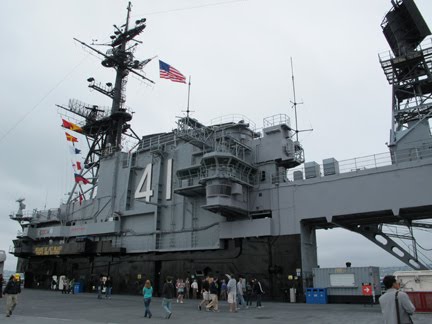
Jill's Journal: Even with Sea World, the San Diego Zoo, and a host of other places to visit in the San Diego area, the #1 attraction here is the USS Midway. This naval aircraft carrier was commissioned as the largest ship in the world in 1945. She was the first ship to be too large to fit through the Panama Canal. Her flight deck alone is just over four acres. Four acres!
She’s been all over the world, including the sub-Arctic, and has done some amazing things, including during wartime in Vietnam and the Persian Gulf. She’s got 18 decks, held a crew of 4,500, and has a fuel capacity of 3.4 million gallons. The USS Midway is so big she used 260 gallons of fuel to move a mile. A mile!
As the longest-serving carrier of the 20th century, she was decommissioned in 1992 and opened to the public in 2004. Time on board the USS Midway is a fascinating glimpse at our military and the lives of the over 225,000 sailors who served on this city at sea during her 47 years in service. In addition, about 25-30 retired aircraft are on the Midway’s flight deck and on her hanger deck and are also open to visitors.
This is “the island” on the flight deck. In here are the bridge/command center for the ship, the control tower/primary flight control for the flights, and the navigation room. This is the only area of the ship with a guided tour (the rest is self-guided) and it is just fascinating.
Our docent (one of over 700 hundred who volunteer on the Midway) served on the Midway himself in 1958. How cool is that?
Getting around the island (and actually, most of the ship) requires the navigation of lots and lots of very steep ladders. Luckily, Victoria just barely met the height requirement.
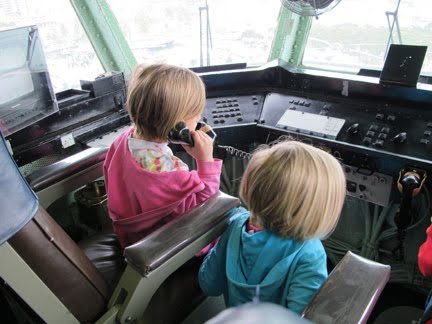
The docent had the girls sit in the “boss” and “mini” chairs in the control tower. These were the spots which controlled all incoming and outgoing flights.
The control tower’s view of the departing runway. It defies logic how planes can take off in such a short space (the arriving runway is longer, but also short). Cables help catapult planes into the air; they also help “catch” landing planes and slow them down in time. What a ride that must be.
There’s a nice view of downtown San Diego from the flight deck.
This is a F-14 Tomcat, the aircraft brought into the nation’s consciousness in “Top Gun.”
Here’s a Sea Knight helicopter, only one of the many aircraft available for viewing on the Midway.
This is inside the Sea Knight.
This sounds silly, but I always wondered how planes didn’t just bounce off the deck in rough seas. They’re tied down…duh!
The Midway is treated to a nice view of “The Kiss” statue on land.
Inside the ship, one gets an intriguing glance into sea life.
Look at those bunks and lockers. Sailors are not afforded much space. Each bunk has a small space underneath for the men’s incidentals.
Look how tight these quarters are! No privacy here.
One of the mess halls.
This is the post office for the whole ship.
The girls each answered questions about what they learned on the Midway to earn their “junior pilot” wings.
The USS Midway is the world’s most visited military attraction. We so enjoyed our time on this amazing aircraft carrier and are grateful our country has opened this up to the public to learn from and enjoy. God bless our military!
She’s been all over the world, including the sub-Arctic, and has done some amazing things, including during wartime in Vietnam and the Persian Gulf. She’s got 18 decks, held a crew of 4,500, and has a fuel capacity of 3.4 million gallons. The USS Midway is so big she used 260 gallons of fuel to move a mile. A mile!
As the longest-serving carrier of the 20th century, she was decommissioned in 1992 and opened to the public in 2004. Time on board the USS Midway is a fascinating glimpse at our military and the lives of the over 225,000 sailors who served on this city at sea during her 47 years in service. In addition, about 25-30 retired aircraft are on the Midway’s flight deck and on her hanger deck and are also open to visitors.
This is “the island” on the flight deck. In here are the bridge/command center for the ship, the control tower/primary flight control for the flights, and the navigation room. This is the only area of the ship with a guided tour (the rest is self-guided) and it is just fascinating.
Our docent (one of over 700 hundred who volunteer on the Midway) served on the Midway himself in 1958. How cool is that?
Getting around the island (and actually, most of the ship) requires the navigation of lots and lots of very steep ladders. Luckily, Victoria just barely met the height requirement.
The docent had the girls sit in the “boss” and “mini” chairs in the control tower. These were the spots which controlled all incoming and outgoing flights.
The control tower’s view of the departing runway. It defies logic how planes can take off in such a short space (the arriving runway is longer, but also short). Cables help catapult planes into the air; they also help “catch” landing planes and slow them down in time. What a ride that must be.
There’s a nice view of downtown San Diego from the flight deck.
This is a F-14 Tomcat, the aircraft brought into the nation’s consciousness in “Top Gun.”
Here’s a Sea Knight helicopter, only one of the many aircraft available for viewing on the Midway.
This is inside the Sea Knight.
This sounds silly, but I always wondered how planes didn’t just bounce off the deck in rough seas. They’re tied down…duh!
The Midway is treated to a nice view of “The Kiss” statue on land.
Inside the ship, one gets an intriguing glance into sea life.
Look at those bunks and lockers. Sailors are not afforded much space. Each bunk has a small space underneath for the men’s incidentals.
Look how tight these quarters are! No privacy here.
One of the mess halls.
This is the post office for the whole ship.
The girls each answered questions about what they learned on the Midway to earn their “junior pilot” wings.
The USS Midway is the world’s most visited military attraction. We so enjoyed our time on this amazing aircraft carrier and are grateful our country has opened this up to the public to learn from and enjoy. God bless our military!
Labels:
aircraft carrier,
control tower,
F-14 Tomcat,
Jill,
military,
Navy,
San Diego CA,
Sea King,
USS Midway,
Victoria
Sunday, April 22, 2012
San Diego Smorgasbord
Jill's Journal: Our girls – especially Madelyn – love mariachis and Mexican folk bands. The catchy tunes the musicians play never fail to get their hands clapping, their feet moving, and their faces smiling.
San Diego is chock full of attractions and interesting areas to wander about while taking in the sights. Over the last few days, we’ve enjoyed Old Town, the Gaslamp Quarter, and Seaport Village. All are distinctly different.
First, Old Town. Although San Diego is now the second-largest city in California and the eight-largest city in the U.S. with more than 1.3 million people, its beginnings were a bit more humble. The original San Diego (or at least the Presidio, a Spanish military outpost) was founded in 1769 and was the first European settlement on the West Coast. It was built on an inland bluff, several miles away from navigable water which really inhibited both imports and exports. When the town began growing outside the Presidio’s walls around 1821, the inland location kept the town’s population at just a few hundred, but also kept it defended against hostile Indians and European enemies.
In 1850, when California was admitted to the Union, San Diego’s population was only 650. The area encompassing this original San Diego is today known as Old Town and is a state historic park. It recreates the early American/Mexican period from settlement in 1821 to the time about 50 years later when Old Town was no longer the heart of San Diego.
There’s all sorts of nooks and crannies to discover as one strolls through Old Town.
Our girls absolutely love the bright colors of traditional Mexican dress. They thought this girl was just beautiful.
El Campo Santa (The Holy Field), an early San Diego cemetery. Nearly 500 people were buried here in the 1800s.
Of course, one of the best things about Old Town (and all of San Diego!) is the food. We have loved grabbing street tacos on the go or patronizing taco trucks or taquerias. When we leave California, how we are going to hate leaving behind the authentic Mexican food. We are hooked, big time. Californians (and I’m sure Texans and those from a few other Southwest states) know that the rest of the country generally misses the mark in their attempts at authentic Mexican cuisine (just as New England clam chowder just can’t be properly replicated outside of New England!). Happily, I suppose, just about every region of the country has their specialty that only they do best.
“Dessert” tortillas, which are flavored strawberry, chocolate, and cinnamon, are one of the few San Diego specialties that can stay right here; no need to worry about what the rest of the country is missing where these are concerned. :)
When and why did Old Town lose its ranking as San Diego proper? In the late 1860s, a gentleman named Alonzo Horton got the bright idea of purchasing 960 acres at the waterfront with the idea of developing it. He quickly fueled a real estate speculation boom. With the easy access to shipping at the bay, merchants were happy to follow Horton to “New Town.” The heart of New Town at its inception was an area known today as the Gaslamp Quarter.
Horton was so successful in “moving” San Diego that by 1871, even the government records were moved to a new county courthouse in New Town. Old Town would forever lose its place as the true San Diego. Today, New Town is still San Diego’s official downtown. Shown in the picture is the Horton Grand Hotel, where the famous/infamous Wyatt Earp lived for at least four years as he invested in real estate (and opened saloons and gambling halls).
Over time, as San Diego grew (and grew), the Gaslamp Quarter became San Diego’s red light district. It was particularly noted as an area of ill repute for the thousands of sailors which were both based here and constantly passed through. The area underwent a renewal several decades ago and today the Gaslamp is 16 1/2 blocks of restored Victorian-era buildings filled with bustling restaurants, nightclubs, and shops.
We visited the Gaslamp Quarter’s William Heath Davis House, the oldest surviving structure in New Town. The first gentleman to attempt to “move” San Diego was Davis, who in 1850 bought this pre-fabricated house from Portland, Maine. He had it shipped around Cape Horn and reassembled in San Diego. However, shortly after, he lost most of his wealth and abandoned San Diego. It would be more than 15 years later that Horton would find success in establishing the new San Diego. Horton would actually live in this house while establishing New Town.
People must have been shorter in the 1800s…
In the 1970s, when a subsequent owner of the home passed away and a room he kept sealed was opened, this working whiskey still was found, as was $5,000 in gold.
This 1921 letter, dated during prohibition, was a “promise” not to transport liquor purchased in nearby Mexico into the U.S. I wonder if that promise was kept? :)
Finally, we also spent some time at Seaport Village, which has no historical significance with the exception of being built on top of landfill over the Punta de los Muertos (Point of the Dead), where a 1782 Spanish expedition buried people who died of scurvy. Now it’s a charming pedestrian mall on the waterfront, with a ton of little shops and restaurants and plenty of street entertainers thrown in for good measure.
The girls found it the perfect place to "people watch" with an ice cream in hand.
San Diego is chock full of attractions and interesting areas to wander about while taking in the sights. Over the last few days, we’ve enjoyed Old Town, the Gaslamp Quarter, and Seaport Village. All are distinctly different.
First, Old Town. Although San Diego is now the second-largest city in California and the eight-largest city in the U.S. with more than 1.3 million people, its beginnings were a bit more humble. The original San Diego (or at least the Presidio, a Spanish military outpost) was founded in 1769 and was the first European settlement on the West Coast. It was built on an inland bluff, several miles away from navigable water which really inhibited both imports and exports. When the town began growing outside the Presidio’s walls around 1821, the inland location kept the town’s population at just a few hundred, but also kept it defended against hostile Indians and European enemies.
In 1850, when California was admitted to the Union, San Diego’s population was only 650. The area encompassing this original San Diego is today known as Old Town and is a state historic park. It recreates the early American/Mexican period from settlement in 1821 to the time about 50 years later when Old Town was no longer the heart of San Diego.
There’s all sorts of nooks and crannies to discover as one strolls through Old Town.
Our girls absolutely love the bright colors of traditional Mexican dress. They thought this girl was just beautiful.
El Campo Santa (The Holy Field), an early San Diego cemetery. Nearly 500 people were buried here in the 1800s.
Of course, one of the best things about Old Town (and all of San Diego!) is the food. We have loved grabbing street tacos on the go or patronizing taco trucks or taquerias. When we leave California, how we are going to hate leaving behind the authentic Mexican food. We are hooked, big time. Californians (and I’m sure Texans and those from a few other Southwest states) know that the rest of the country generally misses the mark in their attempts at authentic Mexican cuisine (just as New England clam chowder just can’t be properly replicated outside of New England!). Happily, I suppose, just about every region of the country has their specialty that only they do best.
“Dessert” tortillas, which are flavored strawberry, chocolate, and cinnamon, are one of the few San Diego specialties that can stay right here; no need to worry about what the rest of the country is missing where these are concerned. :)
When and why did Old Town lose its ranking as San Diego proper? In the late 1860s, a gentleman named Alonzo Horton got the bright idea of purchasing 960 acres at the waterfront with the idea of developing it. He quickly fueled a real estate speculation boom. With the easy access to shipping at the bay, merchants were happy to follow Horton to “New Town.” The heart of New Town at its inception was an area known today as the Gaslamp Quarter.
Horton was so successful in “moving” San Diego that by 1871, even the government records were moved to a new county courthouse in New Town. Old Town would forever lose its place as the true San Diego. Today, New Town is still San Diego’s official downtown. Shown in the picture is the Horton Grand Hotel, where the famous/infamous Wyatt Earp lived for at least four years as he invested in real estate (and opened saloons and gambling halls).
Over time, as San Diego grew (and grew), the Gaslamp Quarter became San Diego’s red light district. It was particularly noted as an area of ill repute for the thousands of sailors which were both based here and constantly passed through. The area underwent a renewal several decades ago and today the Gaslamp is 16 1/2 blocks of restored Victorian-era buildings filled with bustling restaurants, nightclubs, and shops.
We visited the Gaslamp Quarter’s William Heath Davis House, the oldest surviving structure in New Town. The first gentleman to attempt to “move” San Diego was Davis, who in 1850 bought this pre-fabricated house from Portland, Maine. He had it shipped around Cape Horn and reassembled in San Diego. However, shortly after, he lost most of his wealth and abandoned San Diego. It would be more than 15 years later that Horton would find success in establishing the new San Diego. Horton would actually live in this house while establishing New Town.
People must have been shorter in the 1800s…
In the 1970s, when a subsequent owner of the home passed away and a room he kept sealed was opened, this working whiskey still was found, as was $5,000 in gold.
This 1921 letter, dated during prohibition, was a “promise” not to transport liquor purchased in nearby Mexico into the U.S. I wonder if that promise was kept? :)
Finally, we also spent some time at Seaport Village, which has no historical significance with the exception of being built on top of landfill over the Punta de los Muertos (Point of the Dead), where a 1782 Spanish expedition buried people who died of scurvy. Now it’s a charming pedestrian mall on the waterfront, with a ton of little shops and restaurants and plenty of street entertainers thrown in for good measure.
The girls found it the perfect place to "people watch" with an ice cream in hand.
Subscribe to:
Posts (Atom)